

Over the last decade, it has become increasingly common for buyers in S corporation acquisitions to require the target company to complete a pre-closing “F” reorganization, often referred to simply as an “F reorg.” For many business owners, the term is unfamiliar and can sound like a complex tax restructuring. And any time the lawyers and accountants start throwing around terms like “reorganization” or “tax restructuring,” business owners seek clarity and insight as to what is involved.
The good news is that an F reorganization transaction is not a sign that something unusual, risky, or aggressive is happening. In fact, it is often the exact opposite. An F reorganization is a well-established tax planning technique that enables buyers and sellers to bridge competing deal goals while preserving tax treatment. These transactions are expressly recognized under the Internal Revenue Code, Treasury Regulations, and decades of Internal Revenue Service (“IRS”) guidance1,2. When structured and documented properly, F reorganizations are commercially efficient transactions that are routinely respected for federal income tax purposes.
Stock Sale vs. Asset Sale
To understand why these transactions have become so common, and why buyers frequently insist on them as a condition to closing, it is helpful to first examine one of the most fundamental negotiations in any acquisition transaction – is this deal structured as a stock sale or an asset sale. The answer to that question often drives the tax consequences for both parties and, in many cases, leads the parties toward a transaction requiring a pre-closing F reorganization.
A stock sale is often the seller’s preferred structure. In a stock sale, the selling shareholders generally recognize gain on the sale of their stock that is taxed at favorable long-term capital gains rates. Sellers also often prefer a stock sale because it can provide a cleaner exit from the liabilities associated with the business conducted by the corporation. Rather than keeping a legal entity after transferring the business’s individual assets and liabilities, the seller transfers ownership of the entire company to the buyer and can often move on from the business following closing, subject to any negotiated indemnification obligations. In some situations, a stock sale may be operationally needed. If the target has contracts, permits, licenses, or regulatory approvals that have anti-assignment or anti-transfer provisions (or that require preservation of the corporation’s employer identification number for the benefit of the buyer), it often is difficult or impossible for an asset acquisition to achieve commercial objectives. In those cases, a buyer may need to acquire the legal entity itself rather than its underlying assets.
An asset sale can produce a very different result. For sellers, a portion of the purchase price may be allocated to assets that, when sold, generate ordinary income rather than the more favorable capital gain (e.g., depreciation recapture on machinery and equipment). Depending on the target’s asset profile, this ordinary-income component can significantly increase the seller’s overall tax liability. Buyers, on the other hand, often prefer an asset acquisition for several reasons. First, an asset acquisition can provide a tax basis step-up in the acquired assets, allowing the buyer to generate future depreciation and amortization deductions based on the purchase price. In today's environment, where bonus depreciation continues to play an important role in acquisition modeling, these added deductions can create substantial after-tax value for the buyer, and often are taken into account by buyers as part of their valuation metrics when making investment proposals. Second, an asset acquisition generally will allow historical liabilities to remain with the seller. For example, claims arising from pre-closing operations, such as employee disputes, vendor claims, pending litigation, or other legacy obligations, ordinarily will not transfer to the buyer in the absence of an agreement by the buyer to assume them as part of the transaction. While liability allocation ultimately depends on the agreement between the buyer and seller, and applicable law, buyers often view an asset acquisition as a more effective means of limiting exposure to pre-closing risks.
Beyond the traditional stock-sale versus asset-sale debate, additional considerations arise when the target is an S corporation, such as the limitation that only eligible shareholders may own stock in an S corporation (individuals and certain qualifying trusts and estates).3 Accordingly, if the buyer is a partnership, limited liability company, or a corporation, a direct stock acquisition can cause the target’s “S” election to terminate immediately at closing, resulting in the corporation becoming taxable as a “C” corporation going forward. Buyers often seek to avoid that result, which is one of the primary reasons F reorganizations have become such a common feature of acquisitions involving S corporation targets.
Some commentators consider a typical S corporation F reorg structure a compromise of sorts of the competing interests of the buyer and seller. The buyer is able to get the benefit of a tax “step-up” and healthy depreciation and amortization deductions. The seller is able to make a clean exit from the operating business.
How an F Reorganization Typically Works
Now looking at the mechanics of an F reorganization, there are many different forms of transaction that can qualify for this tax-deferred treatment, and many require multiple steps to achieve the desired result. The aim is to move the historic operating business into an entity that is “disregarded” for U.S. federal income tax purposes, while preserving the S corporation shareholder structure at the parent level. The diagram below depicts a common series of steps that qualifies as an F reorganization involving an S corporation:
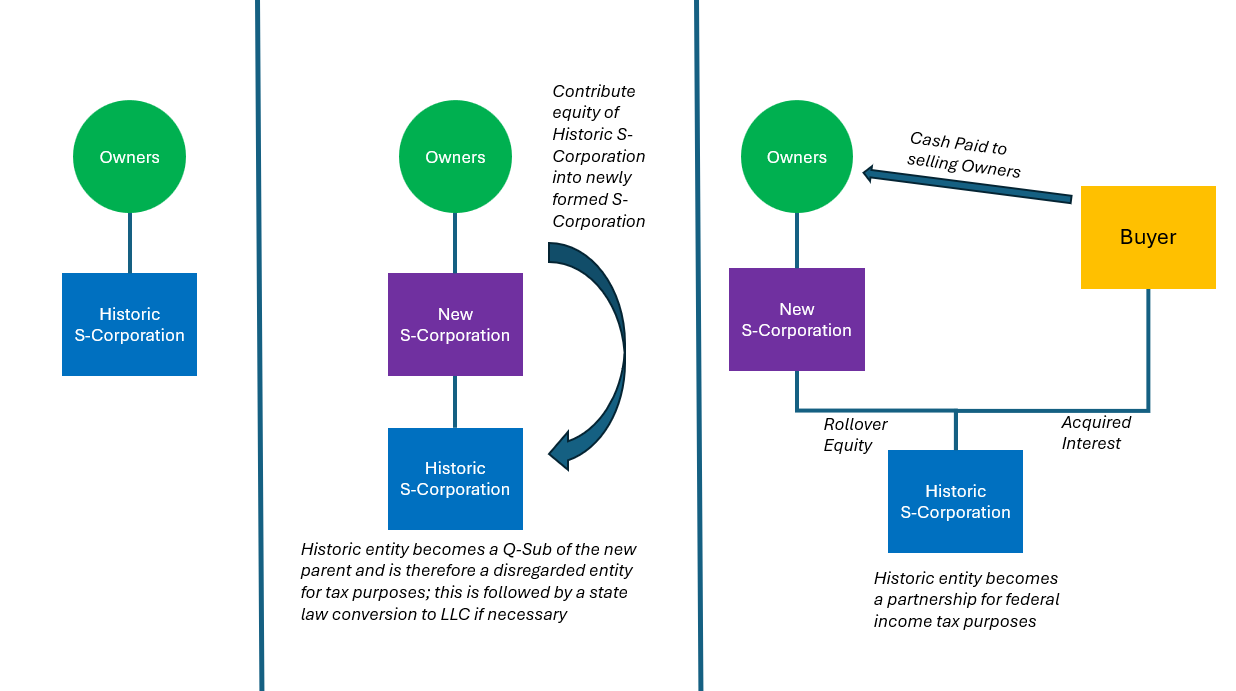
In the example above, the buyer acquires the ownership interests of an entity that is disregarded for federal income tax purposes. As a result, the transaction is generally treated as the purchase and sale of assets held by the entity rather than the acquisition of the ownership interests in the entity. This results in the transaction being treated as the sale of assets for U.S. federal income tax purposes. Here are the specific legal steps:
- Step 1 - Form New Holding Company
- The selling shareholders form a new corporation (“New Holdco”) with identical ownership proportions as the historic S corporation4.
- Step 2 - Contribute Old S Corp Stock to New Holdco
- The shareholders contribute 100% of the stock of the historic S corporation to New Holdco in exchange for New Holdco stock5.
- Step 3 - QSub Election
- New Holdco files IRS Form 8869 electing to treat Old S Corp as a Qualified Subchapter S Subsidiary (“QSub”) of New Holdco. The result for U.S. federal income tax purposes is that the old S Corporation ceases to exist as a separate corporation for federal income tax purposes, New Holdco is regarded as the continuing S corporation, and the old corporation becomes a disregarded entity for U.S. federal income tax purposes.
- Under §368(a)(1)(F), steps 1 through 3 above are combined and treated as a “mere change in identity, form, or place of organization.”
- Step 4 - Convert QSub to LLC (optional but common)
- The disregarded QSub is converted under state law into an LLC (if not so already) which means the LLC is still disregarded for U.S. federal income tax purposes.
- Step 5 - Sell Operating Business
- Buyer purchases 100% of the membership interests in the disregarded LLC. Although the transaction is structured as an equity purchase under state law, because the LLC is disregarded for federal income tax purposes, the acquisition is generally treated as a purchase and sale of the LLC's underlying assets for U.S. federal income tax purposes.
Tax Rules of F Reorganizations
Turning to the tax rules, what exactly is an F reorganization from an IRS perspective? The Internal Revenue Code (the “Code”) includes a section that describes a handful of potential transactions available to corporate shareholders that do not create any added tax and are therefore “tax-free.” Taxpayers can find these in section 368 of the Code and apply to both C corporations and S corporations. These are listed in §368(a)(1) and they are often referred to by the letter of where they appear in the statute. So, the F reorganization appears at §368(a)(1)(F) and is described as “… a mere change in identity, form, or place of organization of one corporation, however effected…”
A common example of this would be a Texas corporation wanting to change its incorporation to Nevada, which can be effectuated by forming a new Nevada corporation, and then having the Texas corporation merge into the Nevada corporation with the Nevada corporation surviving. The historic shareholders of the Texas corporation would receive the same proportional ownership in the newly formed Nevada corporation. At the end of these steps, the operating business has simply effectively changed from a Texas corporation to a Nevada corporation. It has the same assets, liabilities, and ownership. From a tax perspective, nothing has really changed and so the IRS does not feel the taxpayer should be subjected to any tax as a result.
The IRS offers specific detailed guidance on F reorganizations and the various requirements (below are a few examples):
- Treasury Regulation §1.368-2(m) – “Qualification as a Reorganization Under Section 368(a)(1)(F),” which outlines the general requirements and includes several examples.
- Revenue Rulings 75-561 and 78-287 set forth various requirements for F reorganizations.
- Revenue Ruling 2008-18, which clarifies that in an F reorganization involving an S corporation, the S election of the historical operating entity is still in place for the new parent, and the new parent must obtain a new and separate Employer Identification Number (“EIN”).
- Revenue Procedure 90-56 states that the IRS will not issue advance rulings on whether a transaction qualifies as an F reorganization, relying instead on past published authorities.
Tax Compliance Aspects
When a seller goes through an F reorganization prior to closing a transaction, it typically must create a Newco, obtain a new EIN, make a QSub election, and get a few other legal documents in order (e.g., plan of reorganization, board and shareholder consents, contribution agreement, etc.). This reorganization thankfully does not typically require a short period tax return and there is only a relatively simple statement (prescribed by Treasury Regulation §1.368-3) that needs to be attached to the next federal income tax return filing. As a practical point, many taxpayers find it useful to also attach a brief explanation of the steps and entities involved. This isn’t needed but can prove useful if the IRS were to ever select the tax return for review or audit.
Life After an F Reorganization
One aspect of F reorganizations to keep in mind is that, after an S corporation sells its operating business after going through an F reorganization, there will still be an S corporation in place (i.e., New Holdco). The S corporation will be sitting on the cash proceeds from the sale, and often will own so-called “rollover equity” in the buyer or one of its affiliates. In transactions with contingent sales price, earnouts or escrows, it may be necessary or desirable to keep the S corporation in existence for many years until those aspects run their course (including any associated liability exposure). And in line with that, all S corporation requirements still apply. These include (but are not limited to) proportionate distributions from the S corporation to its shareholders, only U.S. citizens or residents can be shareholders, a 100-shareholder limit, and only one class of stock.
Conclusion
While an F reorganization may initially sound like an exotic tax restructuring, it is often simply a tool used to align the competing goals of buyers and sellers in an acquisition transaction. Properly implemented, it allows the parties to achieve a transaction that is treated as an asset acquisition for tax purposes without requiring a direct asset sale by the historic S corporation. Because the rules are highly technical and the sequence of steps matters, taxpayers should work closely with experienced tax and legal advisors before proceeding. Nevertheless, when executed correctly, the F reorganization remains one of the most widely used and respected planning techniques in the acquisition of S corporations.
1. Unless otherwise indicated, all references to “Section” or “§” are to sections of Title 26 of the United States Code, commonly referred to as the Internal Revenue Code of 1986, as amended (the “Code”), and all references to the “Regulations” are to the Treasury Regulations promulgated thereunder.
2. Once a valid reorganization exists, §354 generally provides that no gain or loss is recognized when shareholders exchange stock or securities of a corporation that is a party to the reorganization solely for stock or securities of a corporation that is also a party to the reorganization. Thus, while §368 determines whether the transaction is a reorganization, §354 protects the shareholder from immediate tax on the stock exchange.
3. See Internal Revenue Code §1361.
4. The acquisition holding company need not be organized as a corporation under state law. For example, it may be formed as a limited liability company or other eligible entity that elects to be treated as an association taxable as a corporation for U.S. federal income tax purposes. Nevertheless, practitioners frequently organize the holding company as a state-law corporation because doing so generally simplifies entity classification considerations, avoids reliance on a tax classification election, and often results in a more straightforward implementation of the reorganization and acquisition structure.
5. This is generally intended to qualify under §351.


 Of Counsel
Jason Sharp has more than 30 years of experience counseling private companies and individuals on complex federal income tax matters. His practice focuses on mergers and acquisitions, including buy-side and sell-side tax due ...
 RSS Feed
 Follow us on X
 Follow us on LinkedIn
